

NEWS & EVENTS
Insights on the Latest Trends and Evolving Market Dynamics
Current location:
Home > News > Company News > Gooxi Turin 2U Server Redefines Dual-Socket PerformanceAs the world accelerates into a new computing era defined by AI-native architectures and data-intensive workloads, enterprises are facing rapidly diverging infrastructure demands. The convergence of three major trends—VMware alternatives gaining traction, surging AI workloads, and the rise of edge computing—has pushed compute requirements into a two-tier pattern. On one end, virtualization and distributed storage demand high concurrency and elastic scaling; on the other, AI training and high-performance computing call for stronger I/O bandwidth and uncompromised hardware reliability. Companies need server solutions that can balance versatility, cost-efficiency, and long-term controllability.
In response, Gooxi has upgraded its 2U platform based on the AMD Turin architecture and launched the new dual-socket server SR201-G5, designed to address the key challenges in high-performance computing, large-scale virtualization, and distributed storage. The result is a next-generation infrastructure foundation built for the future.
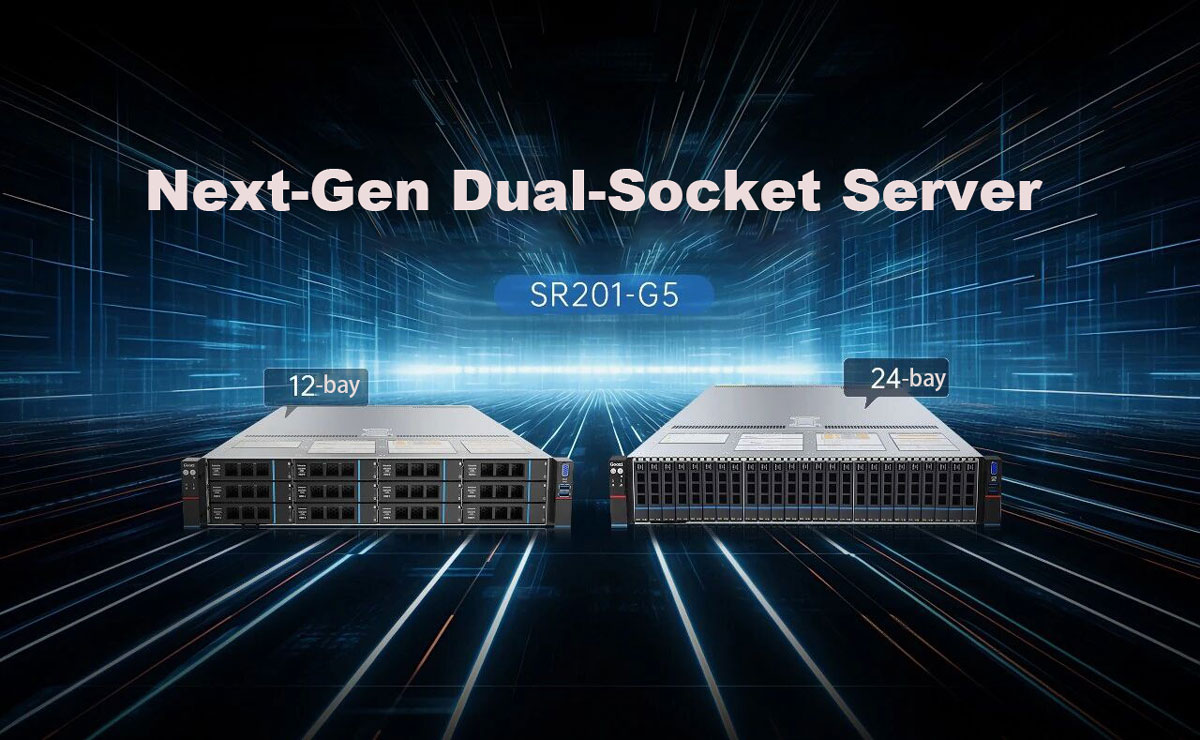
Virtualization and private cloud environments require extreme resource consolidation and flexible allocation. Traditional designs often struggle with VM performance instability, especially when CPU cores and memory bandwidth become bottlenecks. The Gooxi Turin server supports dual AMD EPYC 9005 processors and 24 DDR5 DIMM slots, delivering abundant cores and memory bandwidth to form a highly consistent compute pool. A single server can host hundreds of workloads while maintaining stable performance under peak demand—significantly improving data center efficiency and deployment agility.
In AI training, scientific computing, and large-scale analytics, performance bottlenecks increasingly shift from compute units to data pipelines. Slow data throughput can leave CPU or GPU resources idle. The new platform integrates 12 PCIe 5.0 slots and 24 front U.2 NVMe bays to build a high-speed, end-to-end data channel. PCIe 5.0 provides the bandwidth needed for multi-GPU parallel training and high-speed networking, while the all-NVMe flash pool ensures rapid data access. This architecture eliminates system-level bottlenecks and keeps the data pipeline fully optimized, turning compute power into real-world insights and research outcomes.
AI training, simulation workloads, and 5G UPF/MEC scenarios require multi-GPU acceleration, low-latency networking, and long-term operational stability. The SR201-G5 offers up to 12 PCIe 5.0 slots (including 6 full-height, 4 half-height, and 2 OCP 3.0 NIC slots), supporting flexible deployments of dual-width GPUs and smart NICs, along with InfiniBand connectivity. OCP 3.0 with Multi-host support enables efficient network resource sharing across virtualized or containerized environments.
To meet telecom and mission-critical reliability requirements, the system includes redundant power supplies, N+1 hot-swap fans, a TPM 2.0 module, and redundant BMC firmware—aligning with NEBS/ETSI-level expectations for continuous availability.
Gooxi’s AMD Turin 2U server is built on an engineering philosophy that starts from real application needs and works backward to hardware design. Through coordinated optimization across compute density, direct-attached storage, expansion flexibility, and system-level reliability, it delivers strong support for virtualization, big data, HPC, and telecom edge workloads—avoiding performance waste and unnecessary cost caused by mismatched architectures.
As infrastructure becomes a core component of enterprise competitiveness, choosing Gooxi means choosing a hardware platform built to handle diverse mission-critical workloads—an essential step toward a sustainable, future-ready IT architecture.

Leading Provider of Server Solutions


YouTube